Tags: map
Professional Vault
Date: 2026-09-22
Working notes on building and optimising commercial web experiences - CRO, experimentation, statistics, analytics, UX, commerce and the web development underneath them.
Hi, I’m Alex - a UK-based CRO/Growth Engineer with a background in web development, UX and marketing. These are my personal notes, shared to help team members and clients.
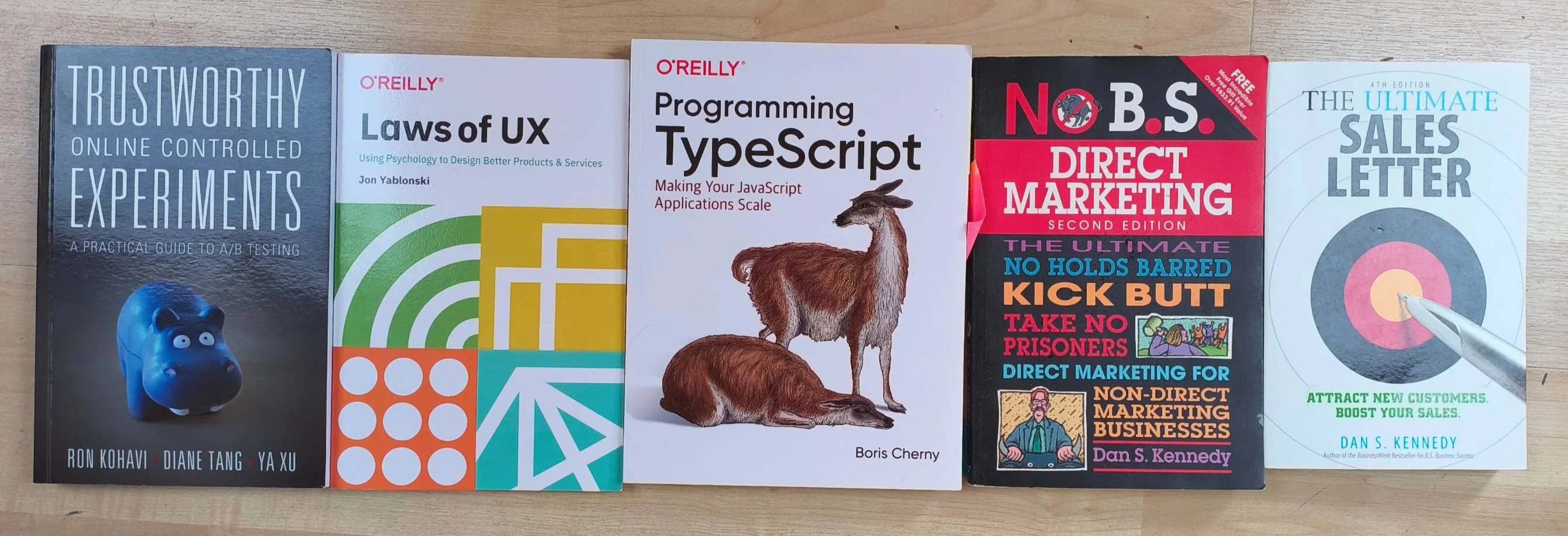
Much of this started as rough Obsidian notes on books like the ones below (pictured: my floor). I’ve since used Claude to make them more readable and better structured.
Start from the work
- CRO — the optimisation loop in the order it happens: find, explain, prioritise, hypothesise, test, learn
- Growth Engineering — the infrastructure under growth work: measurement, experimentation platforms, release safety, lifecycle plumbing
- Design Engineering — from tokens to components to governance
- Guides — whole jobs, start to finish, with the arithmetic worked
Start from a domain
- Statistics — how much you know, given you only measured some of it
- Experimentation — what a change caused, rather than what accompanied it
- Analytics — from an event in a browser to a number someone acts on
- User Experience — what people actually do, and what stops them
- Commerce & Growth — what a customer costs, what they’re worth, how long they stay, what you charge
- Web Development — the browser, languages, architecture, performance and tooling
Elsewhere
- Platforms — specific tools, their shape and their limits. Dated
- Landscape — dated snapshots of where the field stands, never corrected afterwards
- Resources & Communities — books, primary sources, people and communities outside this vault