First-order economics vs LTV
The single most important thing to understand about a DTC business is that the first order rarely makes money. Add up the real cost of fulfilling an order and the cost of acquiring the customer, and the first purchase usually lands somewhere between a small loss and a thin break-even. The profit is in the orders that follow, which carry no acquisition cost because the customer is already yours.
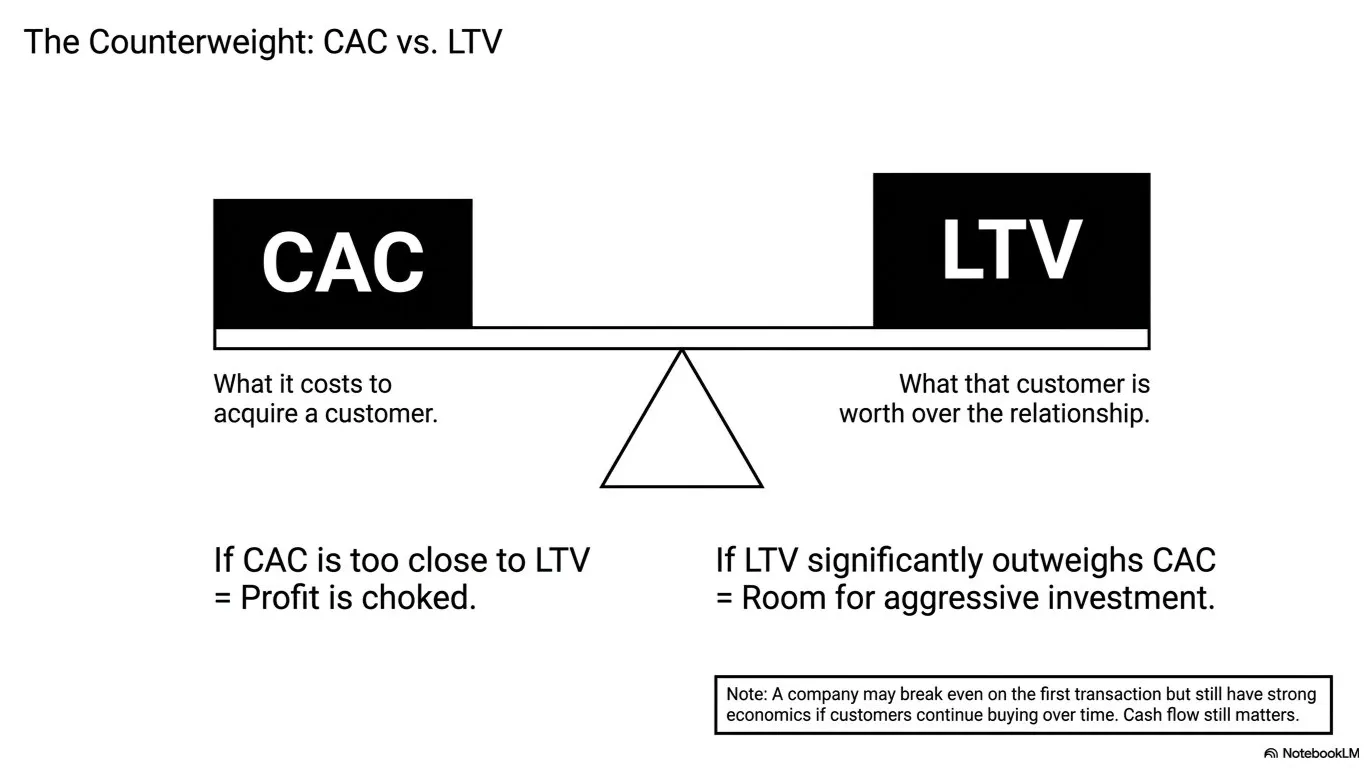
That’s the whole game. A DTC brand is a machine for acquiring customers at a first-order loss and recovering it through repeat purchases. Whether it’s a good business comes down to one comparison: lifetime value against acquisition cost. If repeat purchasing is strong, you can afford to lose money up front and still win. If customers buy once and vanish, no amount of conversion optimisation saves you, because you’re paying to acquire a loss every time.
What this does to conversion rate
Section titled “What this does to conversion rate”CRO instinct treats conversion rate as the goal. First-order economics reframes it as one input among several, and not always the dominant one:
- A variant that lifts first-order conversion by discounting often brings in customers with lower repeat rates. More orders today, lower LTV, worse business.
- A variant that lifts AOV - say a bundle - can improve first-order economics directly by putting more margin into the order that’s running at a loss.
- A subscription or replenishment offer at checkout might convert worse than a one-off purchase but produce customers worth three times as much.
The honest version of DTC CRO judges variants on contribution and downstream LTV, not the conversion number in next week’s test report.
Where it gets people
Section titled “Where it gets people”- Setting CAC targets off first-order revenue. If you cap acquisition spend at what the first order earns, you’ll underspend and lose to competitors who price acquisition off LTV. The whole point is that the first order is allowed to lose money.
- Assuming repeat behaviour you haven’t measured. “We’ll make it back on reorders” is a hope until the repeat-rate data backs it. Plenty of brands found the reorders never came after they’d already bought a season of first-order losses.
- Reading blended LTV when it varies by source. Customers from a discount-led campaign and customers from organic word of mouth have completely different repeat curves. Averaging them hides the brand you’re actually building.