Default bias
Default bias (sometimes called status quo bias) is the disproportionate stickiness of whatever option is preselected, currently active, or framed as the “no decision required” path. Whatever the user would land on by doing nothing is what most of them will land on.
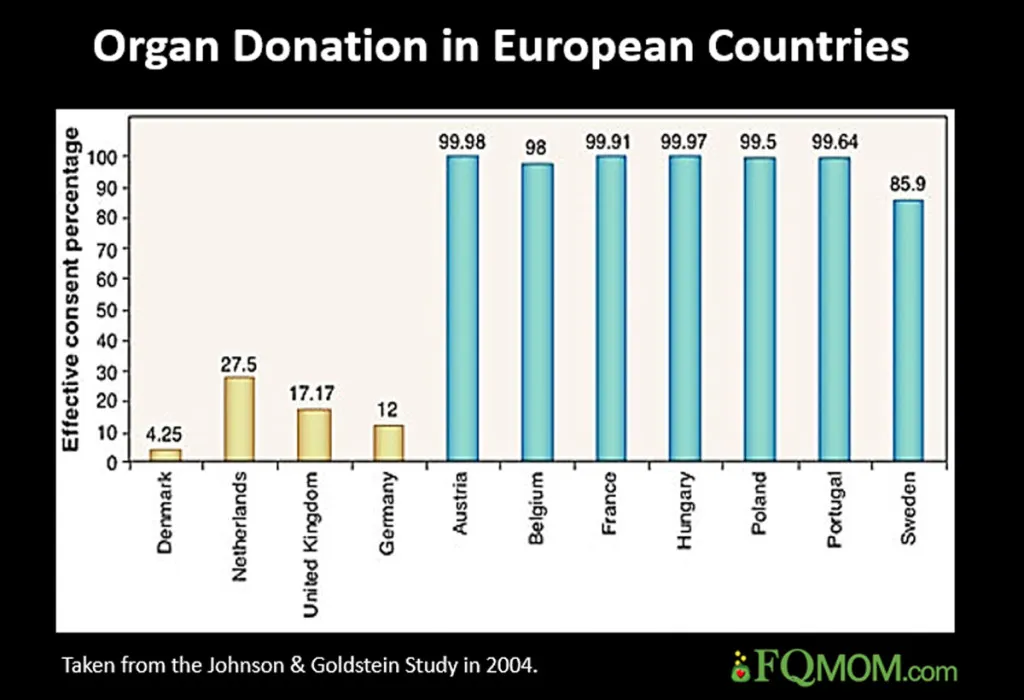
The most-cited evidence is Johnson and Goldstein’s organ donation study. Countries with opt-in donation have under 30% registration. Countries with opt-out have over 90%. The underlying preference isn’t dramatically different. The default is.
Why it works
Section titled “Why it works”Three reinforcing mechanisms:
- Cognitive load. Choosing means evaluating. Accepting the default means not evaluating. The default wins because it’s the cheaper cognitive path.
- Implicit endorsement. Defaults read as the “recommended” or “normal” option, even when no recommendation was intended.
- Loss aversion. Changing the default feels like an active commitment to do something different. Sticking with it feels like the baseline. Switching feels like an unnecessary risk.
The combination is hard to overcome. Even highly motivated users default-stick more often than they realise.
Where it shows up in CRO
Section titled “Where it shows up in CRO”- Pricing tier defaults. The middle tier with “Most Popular” highlighting converts at multiples of the others. The default highlighting is the conversion lever.
- Subscription frequency defaults. “Monthly” vs “Annual” preselection moves billing structure across the user base.
- Quantity defaults. “1” vs “2” as the default quantity on subscribe-and-save items moves AOV meaningfully.
- Shipping defaults. Default delivery option preselection (express vs standard) shifts margin.
- Checkbox states. Pre-checked “subscribe to emails” vs unchecked changes opt-in rates by orders of magnitude (and is increasingly regulated for this reason).
- Form field defaults. Preselected country, currency, units. Anything pre-filled gets used more often.
- Setup wizards. Default app permissions, default integrations, default notification settings. Once set, mostly never changed.
Where to use it strategically
Section titled “Where to use it strategically”The honest framing: defaults are a strategic lever, not a styling choice. The team that thinks about defaults explicitly will out-convert the team that defaults to whatever the developer happened to set.
- For acquisition: pick defaults that lower friction (smaller quantity, monthly billing, standard shipping).
- For LTV: pick defaults that maximise long-term value (annual billing, subscribe-and-save, default tier above the cheapest).
- For ethics: only set defaults the user would consent to with full attention. Defaults that exploit inattention create churn and regulatory exposure later.
Where it backfires
Section titled “Where it backfires”- Defaults that don’t match user intent. A “Subscribe and save” defaulted on for someone who came for a one-off purchase creates cart-page confusion and abandonment.
- Pre-checked boxes for terms users wouldn’t actively agree to. Regulators have noticed. GDPR-style consent rules make these increasingly off-limits.
- Over-optimising the default for short-term conversion. Defaulting to the most expensive option might lift initial conversion but increases buyer’s remorse and refunds.