Peak-end rule
Kahneman’s peak-end rule: when people remember and rate an experience, the memory is dominated by two moments. The peak emotional point (best or worst) and the ending. The average experience throughout barely registers.
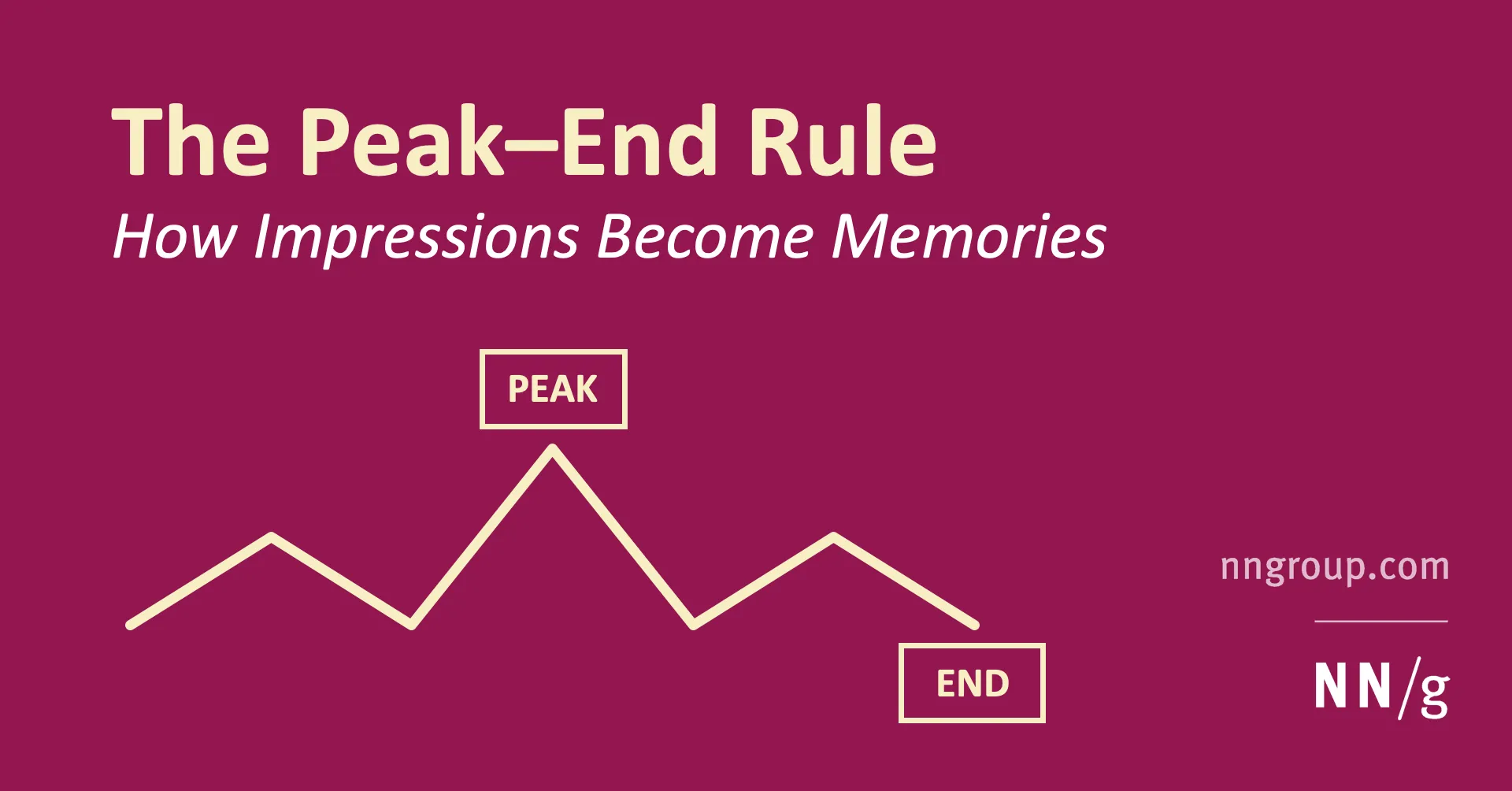
The mechanism is that memory compresses experience. We don’t recall every minute of an event, we recall a few salient moments. The peak and the end are the two that survive the compression. This compression is a System 1 process - automatic, not deliberate.
Where this matters in CRO
Section titled “Where this matters in CRO”Most CRO work optimises the journey to conversion. The peak-end rule says you should also optimise what happens after conversion, because that’s the part the customer actually remembers, and it shapes whether they come back.
Specific applications:
- The order confirmation page - usually treated as a utility (“Thanks, your order is on the way”). It’s actually the ending of the buying experience and the start of the next one. Strong confirmation pages (clear next steps, surprise bonus, well-designed) leave customers with a more positive memory.
- First-use experience - in SaaS or apps, the first time a new user does the core action is often the peak. Optimising for an early “wow moment” is more memorable than optimising the steady-state experience.
- Unboxing - DTC brands obsess over packaging because the unbox is the peak of the early experience. A mediocre product in beautiful packaging gets remembered as a better experience than the reverse.
- Customer service interactions - one strong recovery (refund quickly given, problem fixed gracefully) erases dozens of average interactions. The recovery becomes the peak.
- Email post-purchase sequences - the ending of “I bought this” can be days after the actual purchase. Email cadence and content there shapes the lasting memory.
How it interacts with retention
Section titled “How it interacts with retention”The peak-end rule is one of the reasons retention work is so leveraged. The same product, with a better ending experience, drives more repeat purchase and word-of-mouth. Most “growth loop” mechanics work because they engineer better endings (the share moment, the thank-you, the result).
The asymmetry worth internalising is that this cuts both ways and you can’t average a bad peak away. A single genuinely awful moment - the order that vanished, the support queue that went nowhere - survives the compression intact and becomes the memory of the whole relationship, however many uneventful good experiences sit either side of it. Twenty smooth deliveries don’t dilute one disaster, which is why recovery is worth over-investing in relative to what the incident volume suggests.