Goal gradient effect
People move faster toward a goal the closer they get to it. Show someone they’re 80% done and the remaining 20% feels lighter than the first 20% did. The effect is robust enough that almost every multi-step flow on the modern web uses some version of it - progress bars, completion meters, “step 3 of 4”.
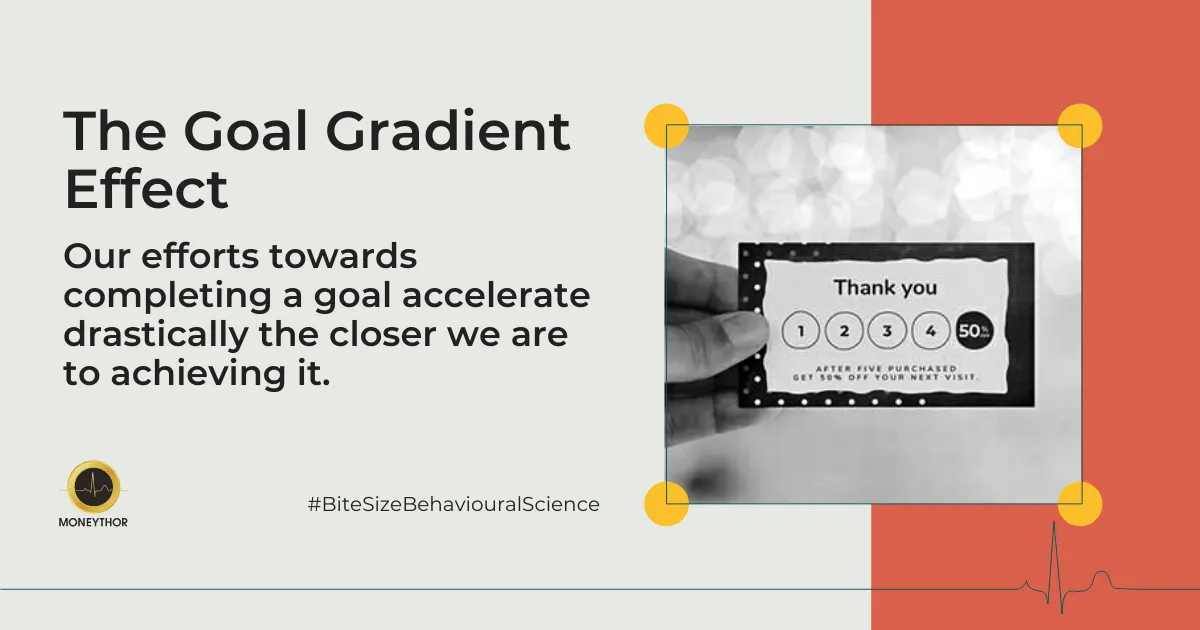
The most useful finding for CRO is the head-start effect. Give someone a loyalty card with 10 stamps required and they collect at a steady rate. Give them a card with 12 stamps required but 2 already filled, and they collect faster than the first group even though the effective work is identical. The illusion of progress does real work.
Where to use it
Section titled “Where to use it”- Multi-step checkouts. A three-step checkout with a visible progress bar usually outperforms a single long form for considered purchases, even though the total work is the same. The progress makes the remaining work feel finite.
- Account setup and profiles. “Profile 60% complete” pulls users to fill the rest.
- Surveys and quizzes. A visible bar dramatically reduces abandonment in anything longer than four questions.
- Onboarding. “You’ve completed 3 of 5 setup steps” works better than five undifferentiated tasks. Pairs well with the Zeigarnik effect - the open loop is what pulls them back.
Where it backfires
Section titled “Where it backfires”- Showing progress before motivation exists. A progress bar on step 1 of 5 with no completed steps tells the user how much work is left without giving them any pull toward finishing. Often worse than no bar at all.
- Bars that lie. If the bar shows 50% at step 1 of 4, the user notices when step 2 takes them to 60%. Misleading progress reads as manipulation on the next visit.
- Putting it on the wrong flow. Goal gradient needs a goal. A progress bar on a browse experience has no target the user is trying to reach. It just adds visual noise.
The cleanest test of whether to use it: does the user have a clear destination and a sense of where they are relative to it? If yes, show progress. If they’re exploring, leave it off.
It’s worth noting the relationship with sunk cost. Goal gradient is forward-pulling (the closer I am, the harder I push). Sunk cost is backward-pulling (I’ve invested this much, I can’t stop now). Both can be loaded onto the same multi-step flow, but they’re not the same lever and conflating them leads to flows that punish abandonment instead of rewarding completion.