MER and blended ROAS
Return on ad spend (ROAS) as the ad platforms report it is one of the most misleading numbers in DTC. Each platform claims credit for conversions it touched, and since a customer sees Facebook, Google and a few others before buying, the platforms collectively claim far more revenue than the business actually made. Add up the ROAS each channel reports and you’ll often find the platforms taking credit for more sales than exist.
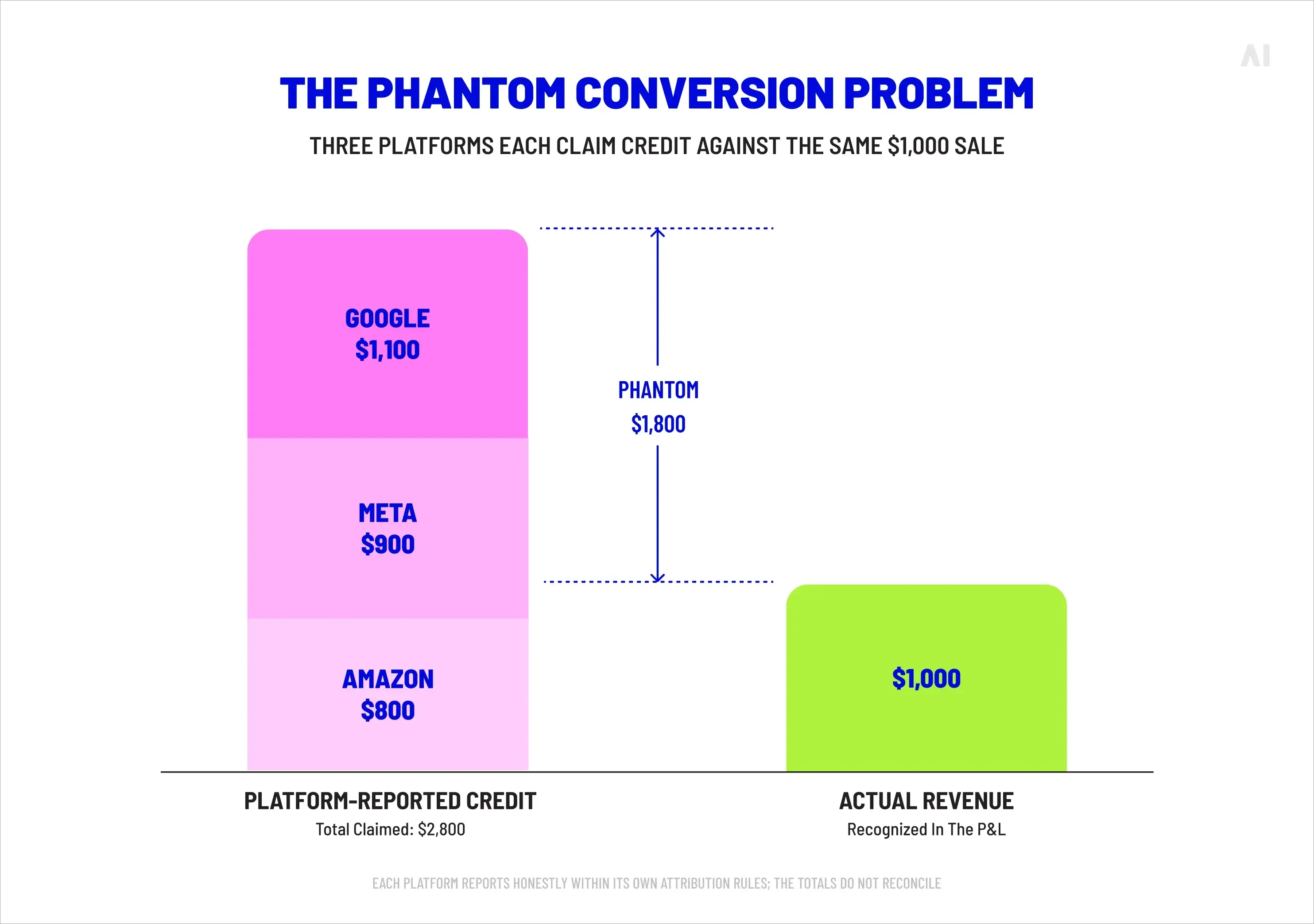
It got worse after the iOS privacy changes cut the signal the platforms use to attribute conversions. They now model and estimate more of it, which means the reported numbers are not just double-counted but partly guessed. Optimising spend off in-platform ROAS is optimising off a number that’s structurally too high and getting softer.
MER as the number that doesn’t lie
Section titled “MER as the number that doesn’t lie”Marketing efficiency ratio (MER) sidesteps the attribution problem by not attributing at all. It’s total revenue divided by total marketing spend across every channel. No channel-level credit, no double-counting, just the question that actually matters: for every pound spent on marketing, how many came back?
MER is sometimes called blended ROAS, and the point of it is exactly that it’s blended. It can’t tell you which channel worked - that’s its limitation - but it tells you the truth about whether the marketing in aggregate is efficient, which the per-channel attribution numbers can’t. The mature setup watches MER at the top for the real efficiency read, and treats platform-reported per-channel numbers as directional signals for allocation, trusted far less than their precision implies.
Where it falls down
Section titled “Where it falls down”- MER can’t isolate a channel. It’s a business-level metric, so when it drops you know efficiency fell, not where. It’s a thermometer, not a diagnosis. Pair it with incrementality tests when you need to know which channel actually drove the change.
- It moves with things that aren’t marketing. A brand moment, a seasonal spike, organic growth all lift revenue and flatter MER, making the paid channels look more efficient than they are. Rising MER isn’t always your ads working.
- Target MER has to account for margin. A “good” MER depends entirely on contribution margin. A high-margin brand can run a lower MER profitably than a low-margin one, so quoting a target MER without the margin context is meaningless.