Value ladders
A value ladder is a deliberate sequence of offers at ascending price points, designed to take a customer from “tried you once” to “spending serious money”. The first offer is cheap or free: a sample, a low-cost entry product, a trial. Each subsequent offer is more expensive and more valuable. The economics work because the lifetime value of an ascended customer pays back the acquisition cost on the bottom rung, plus a lot more.
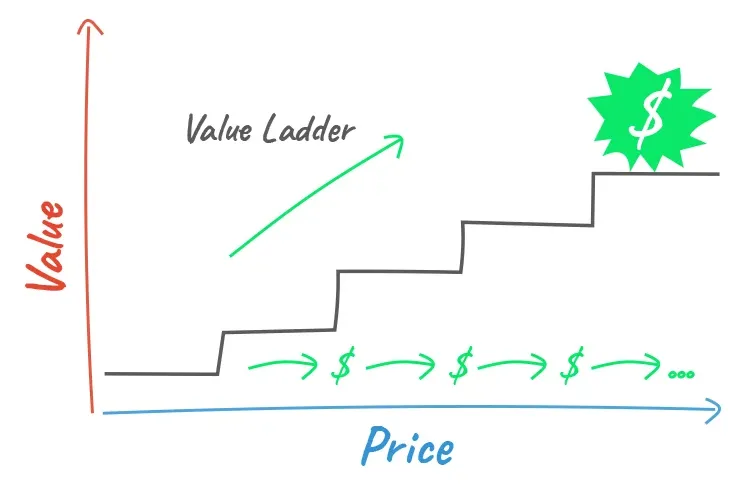
Russell Brunson popularised the term but the pattern is older. McDonald’s “would you like fries with that” is a one-step ascension. SaaS free-trial-to-paid-to-enterprise is a three-step ladder. DTC sample-to-full-size-to-subscription is the modern eCommerce variant.
Why this matters for CRO
Section titled “Why this matters for CRO”CRO usually optimises a single transaction. Ascension models reframe the whole funnel: the right metric isn’t conversion on this page, it’s the probability of moving up the next rung of the ladder. That changes what you test.
Examples:
- Testing a sample-pack landing page where conversion rate is high but ascension to full-size is low, vs a higher-cost landing page where initial conversion is lower but ascension is much higher. The second usually wins on LTV.
- Testing a free-trial flow vs a freemium model in SaaS. Free-trial converts more on the entry rung, freemium ascends slower but at higher absolute volume.
- Testing post-purchase upsells, which are the most underused part of the eCommerce ladder. The customer is already in a buying state and the friction is near zero.
How it interacts with the offer
Section titled “How it interacts with the offer”The ladder is a sequence of offers, not a marketing trick. Each rung needs to be a good standalone offer or the ladder collapses. A weak entry offer means you can’t acquire enough customers to feed the higher rungs. A weak top-rung offer means you’ve built a leaky bucket - good acquisition, no real monetisation.
Where ladders get built wrong
Section titled “Where ladders get built wrong”- Treating it as a funnel with yes/no steps. Customers move up and back down over time, and most never ascend at all. That’s survivable if the bottom rung stands on its own, and fatal if it doesn’t - which is really an argument about the next point.
- Pricing the entry rung at a loss on the assumption you’ll earn it back. This works when CAC is low and ascension is high and reliably. Otherwise you’ve built a subsidy machine that grows its losses in proportion to its success, and the growth looks great right up until it doesn’t.
- Skipping the middle. Going from “tried a £5 sample” to “£200 a month” is too big a step in most categories. The middle rungs feel like they’re not worth building because individually they aren’t very profitable, and their job isn’t profit, it’s making the next step credible.