Growth loops
The funnel metaphor describes acquisition as a one-way pipe - cold prospects come in the top, converted customers leave at the bottom. Growth loops invert this. Existing customers create the conditions for new acquisition through referrals, shared content, UGC, product virality, or paid LTV (high-LTV customers funding aggressive paid acquisition).
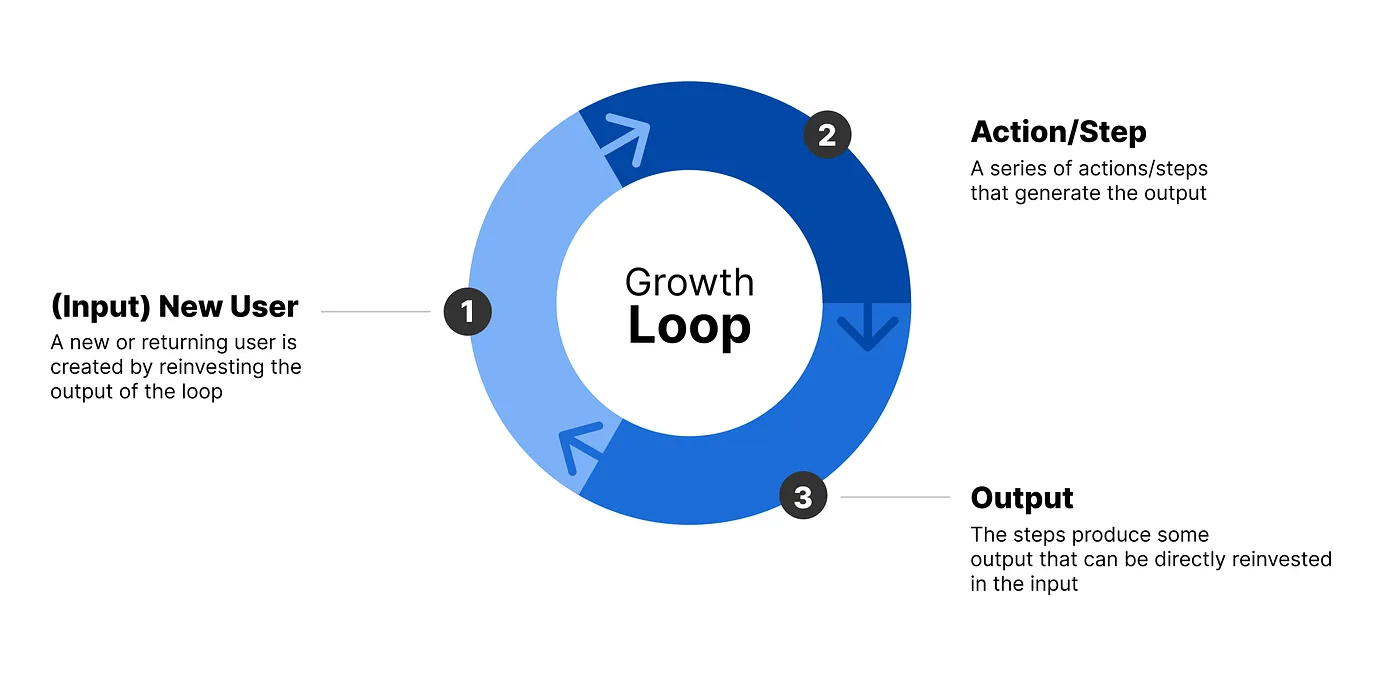
The key property: the output of the loop feeds back into the input. The more customers you have, the more new customers the existing ones produce. Functioning loops compound. Funnels don’t - they run linearly on whatever traffic you can pay for.
Common growth loop types
Section titled “Common growth loop types”A few well-known ones:
- Viral loop. User creates content / invites others / produces output that drives new users (Dropbox referrals, Loom share links, Notion shared docs).
- Content loop. Users create content that ranks on search or shows in social and drives discovery. Reddit, Stack Overflow, Pinterest. Each post is acquisition infrastructure.
- Paid loop. Existing customers generate enough LTV to fund paid acquisition profitably. The loop is: customer pays → revenue → ads → new customer. Strongest at high LTV (SaaS, subscription DTC).
- Marketplace loop. Supply attracts demand, demand attracts supply, both grow. Airbnb, Uber. Notoriously hard to start but devastating once started.
- Referral loop. Customers explicitly refer others, often incentivised. Dropbox, Robinhood, fintechs generally.
Most successful consumer products have at least one functioning loop. Pure-funnel products (most e-commerce, traditional advertising-funded businesses) are increasingly disadvantaged because their unit economics depend on paid acquisition that competitors with loops can outbid.
Where this matters for CRO
Section titled “Where this matters for CRO”CRO traditionally optimises a step in a funnel. Growth-loop thinking expands the surface area:
- Optimising the loop’s output. The share rate, the referral conversion, the content publication rate per user. Often higher-leverage than optimising the initial signup step.
- Loop-aware metrics. “Conversion rate” is a funnel metric. “Loop velocity” (how fast a new user becomes a generator of new users) is the loop equivalent.
- Cross-cohort effects. A change that lifts conversion 5% but tanks referral rate 20% can be a net loss over 12 months. Loop-aware programmes catch this with holdouts.
Where loops don’t apply
Section titled “Where loops don’t apply”Not every business has a loop. Plenty of profitable companies run on funnel mechanics indefinitely - especially in categories where the purchase is infrequent (insurance, mortgages, major appliances) or where there’s no natural sharing or virality (industrial B2B). Forcing loop-thinking onto a non-loop business produces awkward referral programmes that nobody uses.
The question to ask: is there a plausible mechanism by which an existing customer creates value that brings in a new customer at meaningful volume? If yes, work on that loop. If no, accept that your acquisition is funnel-only and focus there.