Attribution models
When a customer converts, you usually want to know which marketing touchpoints contributed. Did the Facebook ad do it? The blog post they read three weeks ago? The brand search they did this morning? Attribution models are the rules you apply to decide how to split the credit.
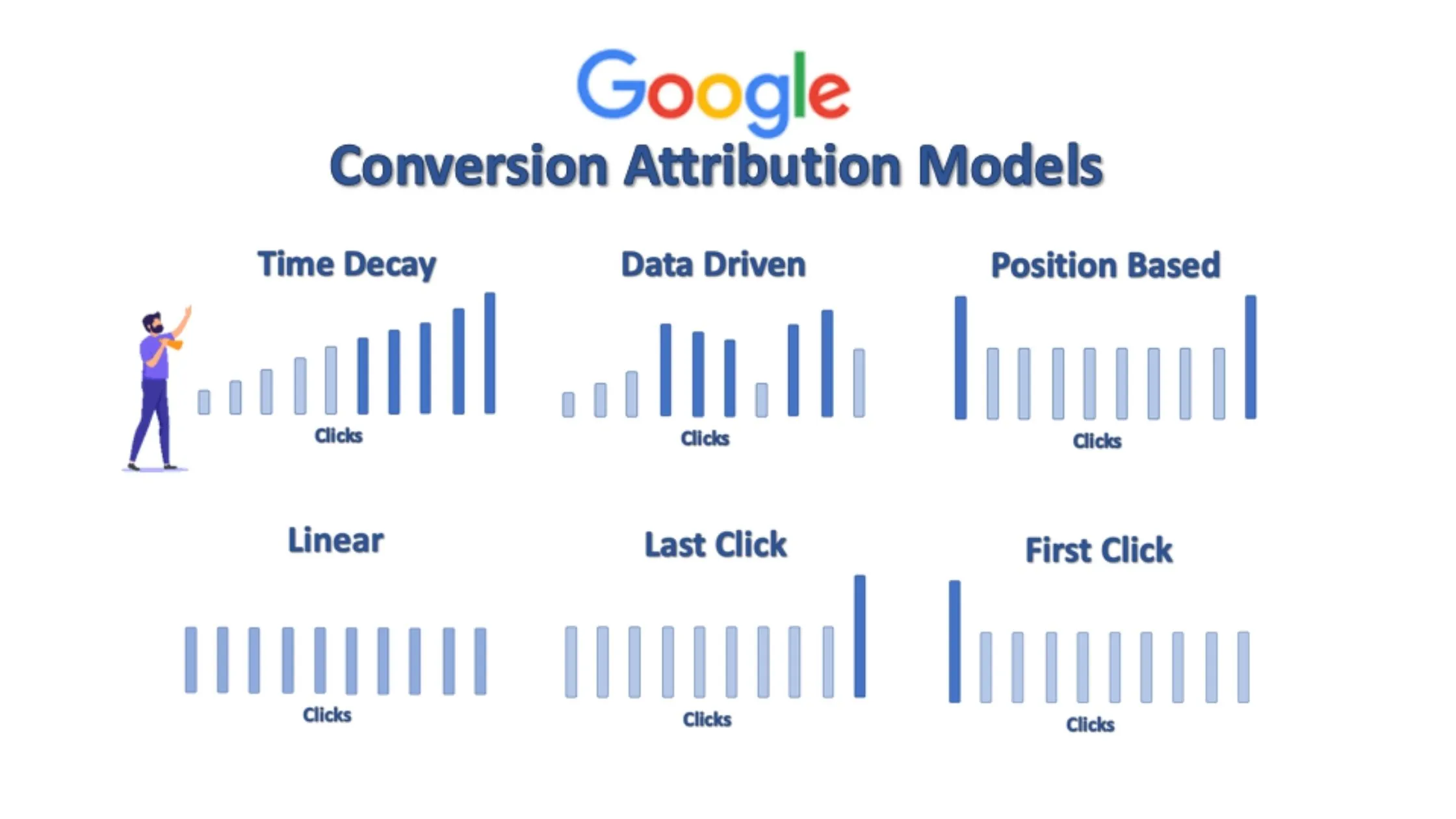
The standard models:
- First-touch - all credit to the first interaction. Favours awareness channels (paid social, display, content).
- Last-touch - all credit to the final interaction. Favours capture channels (brand search, retargeting, email). The default in most analytics tools historically.
- Linear - equal credit to every touchpoint.
- Time-decay - more credit to recent touchpoints. A compromise between linear and last-touch.
- Position-based (U-shaped) - 40% to first, 40% to last, 20% split across the middle.
- Data-driven - machine-learning model that estimates contribution from observed conversion paths. GA4’s current default.
Different models tell different stories. The same conversion can look like a “TikTok win” under first-touch and a “brand search win” under last-touch, even though both touchpoints were necessary.
Each model has a conclusion it reliably produces, which is worth recognising before you act on one. Last-touch will tell you brand search is your best channel, when brand search is mostly the closing touch on demand that something else created - defund the something else and watch brand search shrink. First-touch will tell you to buy more of whatever sits at the top, when those channels wouldn’t convert without the lower-funnel reinforcement that first-touch gives no credit to. Neither is lying exactly. They’re both answering a question about credit allocation that has no true answer.
Why this matters for CRO
Section titled “Why this matters for CRO”CRO mostly happens at the last-touch end of the funnel. You optimise the page someone lands on right before they convert. So your test results show up cleanly in last-touch attribution but get diluted in first-touch or linear models. If your team optimises for first-touch ROAS, your CRO wins might look smaller than they really are.
The deeper problem: attribution is broken across the industry. iOS 14’s App Tracking Transparency, third-party cookie deprecation, and signal loss generally mean the conversion paths most platforms see are incomplete. Facebook reports more conversions than actually happened because their attribution window catches anything that touched their pixel. Google reports more than that. Sum the channel reports and you’ve claimed 130% of your actual revenue.
What to actually do
Section titled “What to actually do”- Pick one attribution model as the source of truth (usually GA4 data-driven, or last-touch if you want simplicity) and stick to it. Don’t switch between platforms’ reports.
- Treat all attribution as directional, not absolute. “Channel X is roughly 30% of attributed revenue” is useful. “Channel X drove £142,000 in revenue this month” is false precision.
- For CRO specifically: report tests in absolute revenue lift on the test page, not as attribution shifts.
- Run incrementality tests (geo-holdouts, paused-spend experiments) on big channels to ground-truth attribution. The only honest measure of channel impact.
- Look at the LTV of customers by source, not just the conversion count. A channel can look mediocre on first-order ROAS and be your best one on repeat behaviour, and no attribution model will surface that because they all stop counting at the conversion.