Awareness stages
Schwartz’s five stages of awareness (originally a direct-response copywriting framework) describe where a potential buyer sits in their understanding of the problem and the solution. The stage they’re in dictates what you need to say to move them forward. Most CRO copy fails because it’s written for the wrong stage.
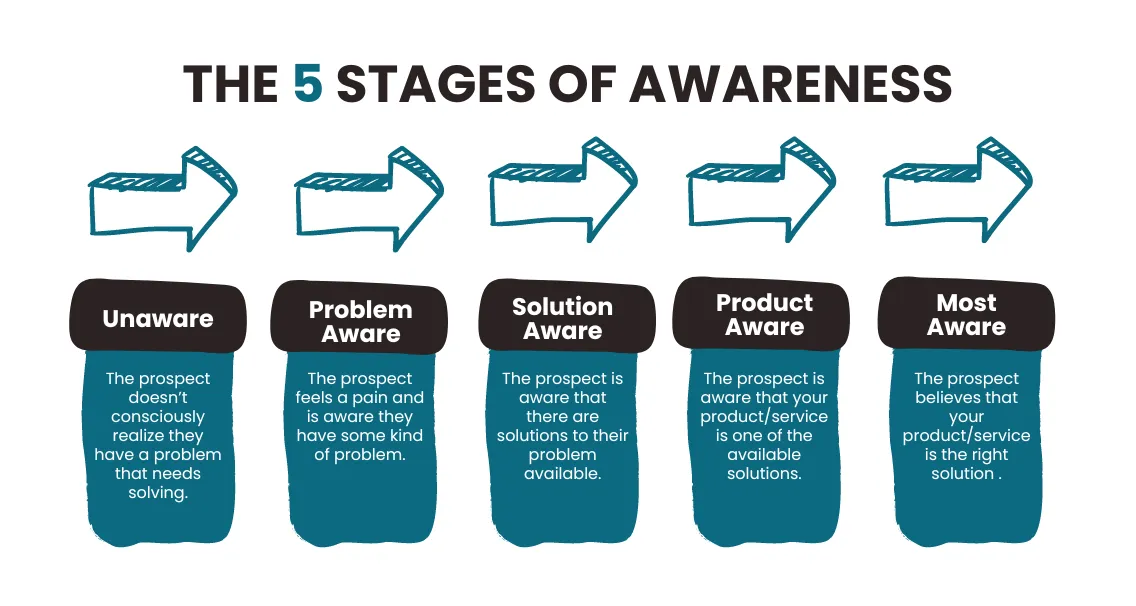
The five:
- Unaware - doesn’t know they have a problem. The hardest sell. You’re not selling a solution, you’re surfacing a problem they didn’t know they had.
- Problem-aware - knows they have a problem, doesn’t know there are solutions. You’re educating them that solutions exist.
- Solution-aware - knows solutions exist, doesn’t know about you specifically. You’re explaining what makes you different.
- Product-aware - knows about you, hasn’t bought. You’re handling objections: price, fit, risk.
- Most aware - knows you, knows they want it, hasn’t pulled the trigger. You’re closing: offer, urgency, guarantee.
This maps onto where the visitor sits in the broader marketing funnel - unaware and problem-aware are deep in TOFU, most-aware is BOFU and beyond.
Why this matters in CRO
Section titled “Why this matters in CRO”The traffic hitting your site is a mix of all five stages. Paid social usually skews towards unaware or problem-aware (you interrupted them). Brand search and direct traffic skews towards solution-aware or product-aware (they’re looking specifically). Organic search varies depending on the keyword intent, and assistant-mediated discovery skews later still, because the comparison happened before the click.
If your homepage is written for product-aware traffic (heavy on features, light on problem framing) but most of your visitors are problem-aware (don’t yet believe they need a product like yours), you’ll struggle to convert no matter how good the design is. The copy isn’t speaking to where they actually are.
How to apply it
Section titled “How to apply it”- Audit your traffic by stage. Paid traffic from cold interest-based audiences is mostly unaware or problem-aware. Branded search is product-aware. Email is wherever your list is, usually solution-aware or further along.
- Match landing pages to stages. Cold paid traffic shouldn’t land on your generic homepage. It should land on a page that surfaces the problem and earns the right to introduce your solution. Branded traffic can go to the product page directly.
- Adjust the offer by stage. Cold visitors need more risk reversal, proof, and problem framing. Warm visitors need less of all three and more of the closing mechanics (urgency, bonuses, payment terms).
- Test by stage, not just by variant. The same headline test will produce different winners on cold vs warm traffic because the audiences are at different stages.
The framing is where this gets practical. The same product positioned at two stages reads completely differently - “stop wasting hours every week on X” is problem-aware, “the only X tool that also does Y” is solution-aware - and those are testable against each other on the same traffic rather than being a positioning decision you make once and never revisit.
Two caveats on the model. The stages aren’t discrete and people don’t only move forwards: someone who was product-aware in March is back to solution-aware by June because life intervened and a competitor’s ad landed in between. And the progression is a description of a population, not a promise about an individual, so treat the stage mix of a traffic source as a distribution rather than a label.