Jobs to Be Done
People don’t buy products, they hire them to do a job. The job is the underlying progress the user is trying to make - the situation, the motivation, the desired outcome. JTBD shifts the question from “what’s our product” to “what is the user actually trying to accomplish, and what’s standing in the way”.
For CRO this is the most useful lens for generating hypotheses that aren’t shallow. “Test green vs orange CTA” is a UI hypothesis. “The PDP doesn’t address the anxiety this customer brought with them” is a job hypothesis - and the test that follows might be a copy change, a trust signal, a guarantee, or a comparison table, depending on the job.
The job statement
Section titled “The job statement”The canonical format: “When I [situation], I want to [motivation], so I can [expected outcome]”. Three parts because all three matter.
“When I’m shopping for a birthday gift for my mum, I want to find something that feels considered, so I don’t look like I bought the first thing I saw.”
That sentence dictates the whole funnel. Filters by recipient, curated collections, gift wrap upgrade, handwritten note option. None of those are obvious from “we sell jewellery”. All of them are obvious from the job statement.
Forces of progress
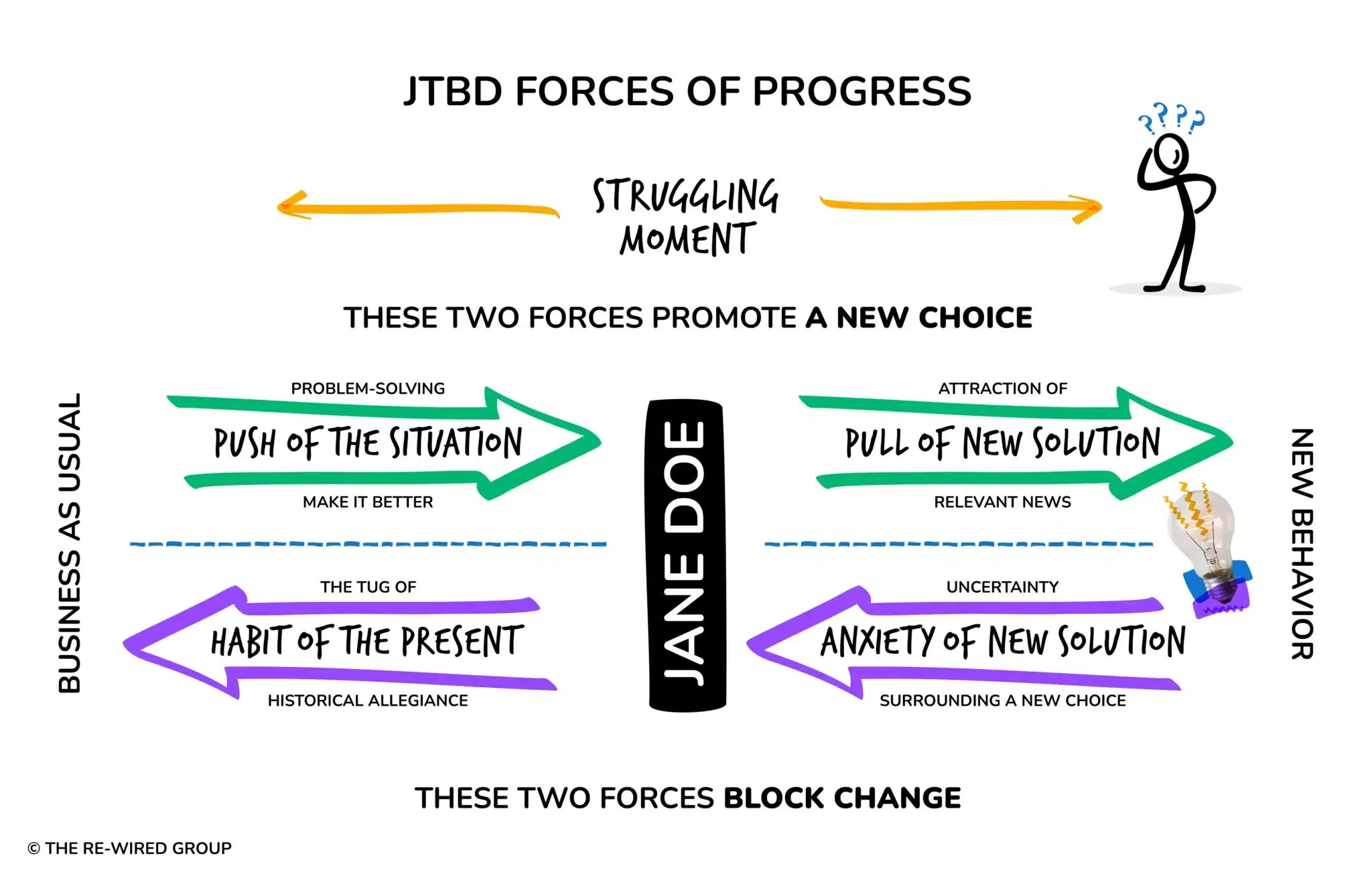
Section titled “Forces of progress”The model that goes with JTBD. Four forces act on a user considering a switch:
- Push. The problem with the current situation that’s making them look elsewhere.
- Pull. The appeal of the new solution.
- Anxieties. Worries about the new solution - will it work, will I look stupid, can I return it.
- Habits. Inertia of the current solution, even when it’s mildly broken.
Push and pull get the user looking. Anxieties and habits stop the purchase. Most CRO copy spends 90% on pull (features, benefits, social proof) and almost nothing on anxieties (returns, guarantees, sizing, fit, “what if I don’t like it”). The forces model is a checklist that catches the imbalance.
Where it goes wrong
Section titled “Where it goes wrong”The trap is treating the product category as the job. “People hire mattresses to sleep on” isn’t a job statement. “When I’m moving into my first flat and don’t want to spend three weekends comparing brands, I want a mattress that’s been vetted by people I trust, so I can tick it off and get on with the move” is. The first leads to feature pages. The second leads to the entire bed-in-a-box playbook - curated comparisons, generous trials, no-decision returns.
The other trap is one product, one job. Most products serve multiple jobs in different contexts. A skincare cream might be hired for “fix my breakout before Friday” or “build a long-term routine I trust” - different jobs, different anxieties, different conversion paths. Trying to address both on the same page muddles both. The awareness stage the user is in usually tells you which job is live.
JTBD interviews (switch interviews) sit firmly inside qualitative research - the format is structured but the work is conversational. The yield is uneven; one good interview is worth a quarter of vague survey data.