Fogg behaviour model
BJ Fogg’s behaviour model (developed at Stanford’s Behaviour Design Lab) compresses the question “why didn’t they do the thing?” into three variables:
B = MAP
Behaviour = Motivation × Ability × Prompt
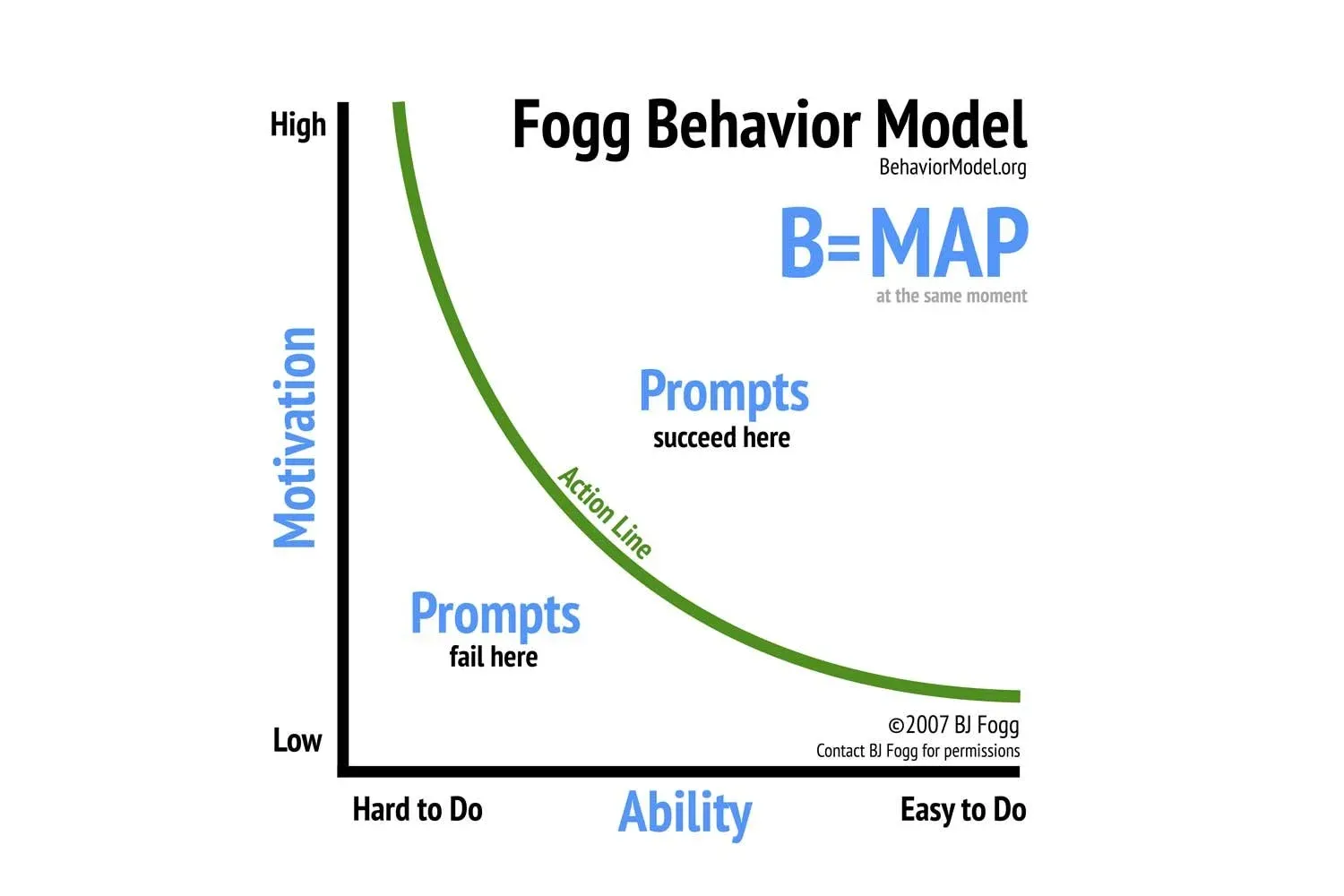
All three are needed simultaneously. If any one is zero, the behaviour doesn’t happen. Motivated and prompted but unable? No conversion. Able and prompted but not motivated? No conversion. Motivated and able but not prompted (at the right moment)? Still no conversion.
The model elegantly explains why CRO tests often fail without obvious reason. You raised motivation with better copy but the form is still too long (ability problem). You simplified the form (ability) but the CTA is buried below the fold (prompt problem). You moved the CTA up (prompt) but the visitor doesn’t yet care about your offer (motivation problem).
What each variable looks like in CRO
Section titled “What each variable looks like in CRO”- Motivation - how much the visitor wants the outcome. Driven by the offer, the framing, the perceived value, the urgency. Highest leverage point but slowest to move.
- Ability - how easy it is to do the thing. Form length, page speed, friction, complexity of the decision. Easiest to fix and often the cheapest test.
- Prompt - whether the call to action is in front of them at the right moment. Button placement, exit-intent triggers, lifecycle email timing, retargeting frequency.
The high-leverage move depends on which is the bottleneck. If your visitors are bouncing without engagement, motivation is the problem. If they’re engaging but not converting, ability is. If they’re reading the whole page but not clicking, prompt is.
Why “make it simpler” is usually the right first test
Section titled “Why “make it simpler” is usually the right first test”Of the three, ability is the cheapest to move. Cutting form fields, removing friction, simplifying the decision - these are mechanical changes with predictable lift. Motivation work is creative and harder to test. Prompt is usually a second-order effect (you can’t prompt someone with no motivation).
So the standard CRO sequence is: simplify (ability), then strengthen (motivation), then refine prompts. Most programmes that “plateau” have hit the ceiling on ability and need to start working on motivation, but the team keeps shipping more friction-reduction tests because that’s what they know how to test.
There’s a measurement reason that plateau persists, not just a habit reason. Motivation changes - copy, value propositions, framing - interact strongly with traffic temperature and segment, so the same change helps one audience and does nothing for another. That’s more variance, which means more sample for the same power, which means motivation tests are slower and fail to reach significance more often. Ability tests keep winning the prioritisation argument partly because they’re genuinely easier to prove.
One scope note: the model describes a single decision, not a funnel. It applies at every step rather than mapping onto the steps, so “we’re weak on prompt” is a claim about a specific moment and not about the journey.