Zeigarnik effect
Unfinished tasks hang around in your head. Completed ones get filed away and stop occupying attention. That asymmetry is what makes progress bars, cart abandonment emails, and quiz funnels work - they all create or preserve an open loop the user wants to close. (Distinct from the curiosity gap, which is about unfinished information rather than unfinished tasks.)
How this shows up in CRO
Section titled “How this shows up in CRO”A few specific patterns that lean on the Zeigarnik effect:
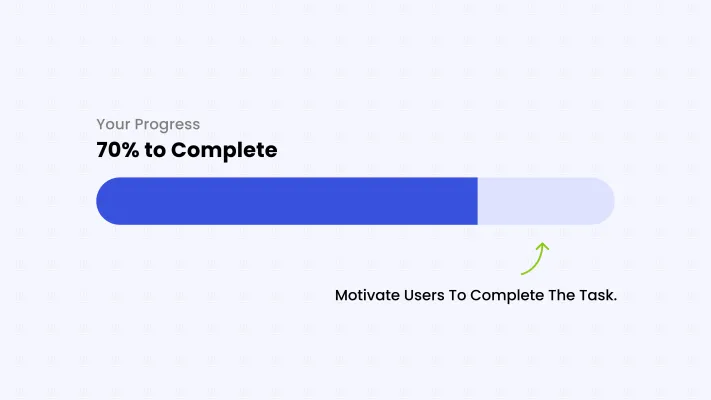
- Progress bars in multi-step processes - showing “Step 2 of 4” gives the user an unfinished task to complete. Without the progress bar, each step feels like a self-contained interaction. With it, each step is a checkpoint toward an open loop.
- Saved-for-later mechanics - wishlists, saved searches, started-but-not-finished applications. Each one creates an open loop the user is more likely to return to. Email reminders amplify this.
- Cart abandonment emails - the cart is an unfinished task. The Zeigarnik effect explains why even simple “you left something behind” emails recover such a large fraction of revenue.
- Quiz funnels - “Get your personalised result” pulls the user through because the question “what is my result?” is the open loop. Stopping mid-quiz is leaving the question unresolved.
- Profile completeness indicators - “Your profile is 60% complete” is a classic Zeigarnik trigger. The 40% gap feels urgent in a way the same number presented neutrally wouldn’t.
Where the effect breaks
Section titled “Where the effect breaks”- When the open loop is too long-running. Profile-completeness bars that have been at 60% for three years stop working. The user has habituated to the incompleteness.
- When the open loop is too high-stakes. Some unfinished tasks (cancelling a subscription, finishing a tax return) generate avoidance rather than completion drive. The Zeigarnik effect assumes the task is do-able.
- When the user doesn’t care about closure. Open loops only work if the user wants the resolution. An unfinished sentence about a topic they don’t care about doesn’t drive engagement.