Voice of customer research
Most research asks customers questions. Voice of customer research reads what they said without being asked, which is usually the better source, because nobody was primed by the question and nobody was trying to be helpful.
The raw material already exists. Your reviews, your competitors’ reviews, support tickets, chat transcripts, return reasons, post-purchase survey free text. None of it costs anything to collect and almost nobody works through it systematically. I run this at the start of most engagements, before any test gets written.
Survey answers are filtered twice: by what the person is willing to tell you, and by what your question suggested. A review is written to warn or recommend a stranger, which produces sharper language and a truer ordering of what mattered. It also arrives in volume, which is the actual point - most teams can list their objections, very few can tell you which one costs the most. The competitor reviews are the part people skip and the part that pays, because your own are written by people who bought, while a competitor’s one-star reviews are written by people who chose the alternative and regretted it.
The method
Section titled “The method”Collect everything - your reviews, the top three or four competitors, support tickets if you can get them - keeping the rating, date and product alongside the text.
Classify each piece by topic and sentiment. This is the step that used to make the exercise impractical, because hand-coding 8,000 reviews is a fortnight of someone’s life. A short Python script passing each review through a language model does it in an afternoon for a few pounds, and it derives the topics rather than you supplying them. That’s most of the time saving, and it’s also the better method: a taxonomy you write in advance can only find the objections you already thought of, which is the opposite of why you’re doing this.
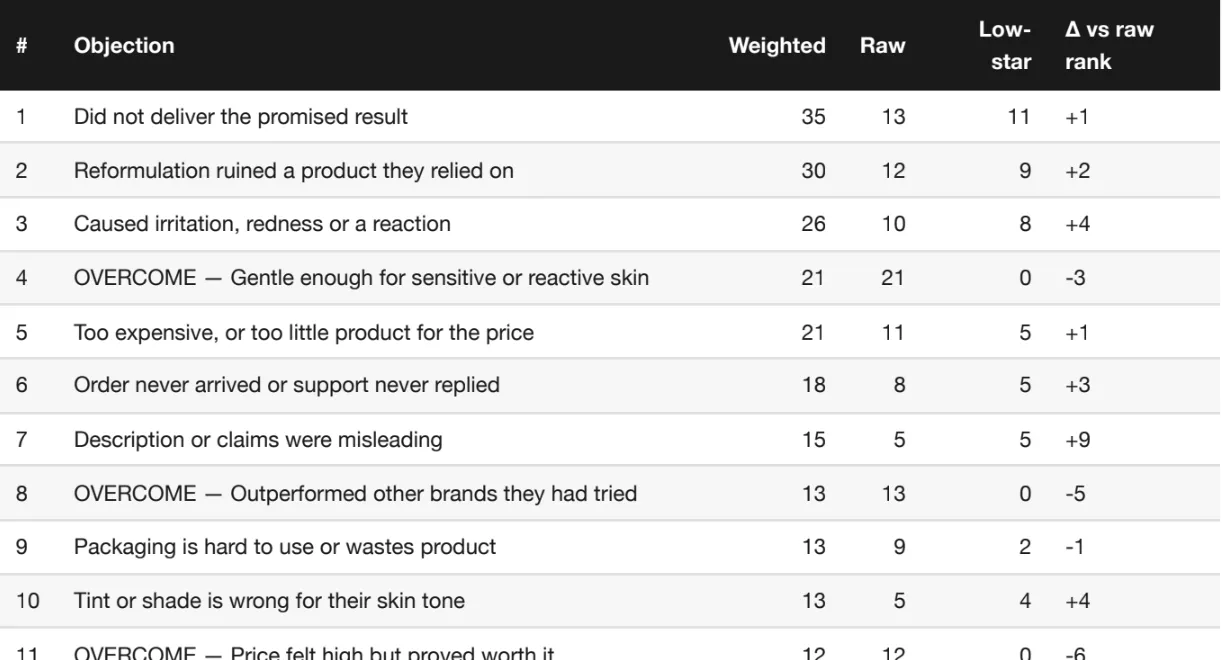
Rank the topics by frequency and intensity together. Mentioned constantly and neutrally is table stakes. Mentioned rarely and furiously is a tail risk. Mentioned often and negatively is the objection sitting between your traffic and your conversion rate.
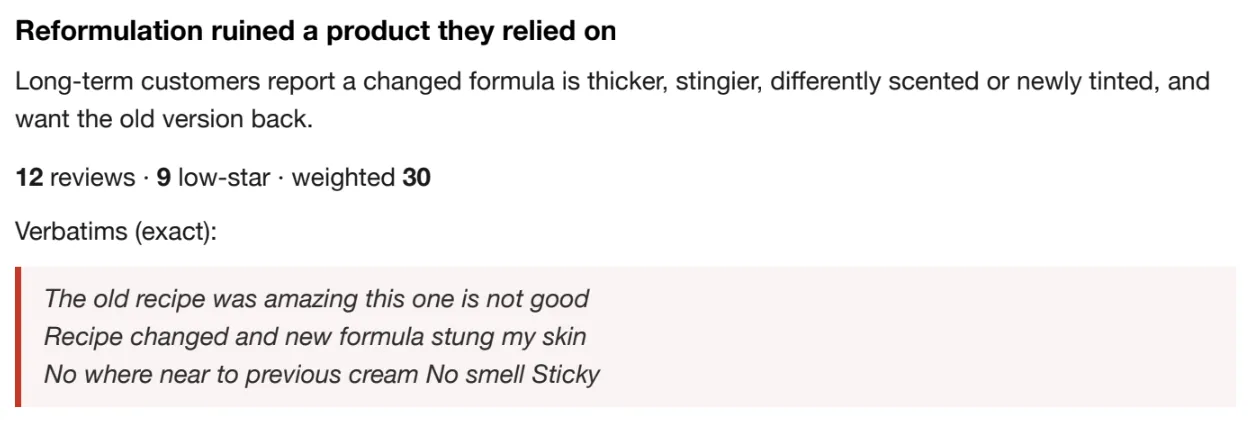
Read the extremes by hand. The ranking tells you what to address. The verbatims tell you how to say it, and customers describe their own objections better than any copywriter will.
What you do with the output
Section titled “What you do with the output”The ranking is a build order.
- Landing page structure. Answer the top three objections in order down the page, which gives you an architecture derived from evidence rather than from the last agency’s template.
- Sitewide messaging. A proof point that keeps appearing in positive reviews and nowhere on the site is free conversion. Fabric quality in that table is doing nothing for the brand.
- The offer. When the top objection is fit or risk, the answer is risk reversal rather than words. That’s an offer change, and needing evidence to win that argument is most of why you did the research.
- Test hypotheses. Each ranked objection is a mechanism you can name, which is the part most hypotheses are missing.
It maps onto the forces of progress too. Negative topics are the anxieties blocking the switch, positive ones are the pull, and most sites lean hard on pull while leaving the anxieties untouched.
What it can’t tell you
Section titled “What it can’t tell you”Reviews are written after the purchase, by people who completed it, so every objection that actually stopped someone is missing by construction. That’s the real argument for mining the competitor set, and it’s why this never replaces behavioural data. Voice of customer ranks what people talk about; analytics ranks where they leave; the two disagree more often than you’d expect. Stated reasons aren’t causes either, because people rationalise decisions they made for other reasons. Use the corpus to decide what to say and behaviour to decide where to say it, and don’t read the volumes as population sizes - reviewers skew heavily toward the delighted and the furious.